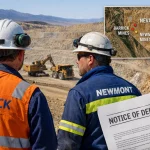
Anglo American just handed Mitsubishi Corporation a seat at one of the UK’s most ambitious mining projects. And not a small seat : potentially 25% of the entire Woodsmith polyhalite operation.

The definitive investment agreement, finalized this month, reshapes the financing structure for a project that’s been burning through capital since 2017. Until Anglo American’s board makes its final investment decision in 2028, the mining giant will continue funneling approximately $300 million annually into construction. That’s not maintenance spending. That’s active site development while the business case gets workshopped with Tokyo.
Mitsubishi gets an initial equity position now, with an option to scale up to 25% : or negotiate something different : when Anglo American pulls the FID trigger. The structure gives both parties breathing room. Anglo American secures committed capital without diluting immediately. Mitsubishi gets market validation time before going all-in.
What Makes Polyhalite Worth the Bet
Woodsmith isn’t a copper play or a battery metals gamble. It’s a fertilizer project. Specifically, an underground mine designed to extract polyhalite : a naturally occurring mineral that contains potassium, sulfur, magnesium and calcium in a single package.
The end product is branded POLY4, and Anglo American’s pitch is straightforward: it’s a multi-nutrient fertilizer that doesn’t require chemical processing. Just mine it, crush it, ship it.
More Read



The project is engineered to produce up to 13 million tons of POLY4 annually once operational. First production is slated for 2032, with a mine life stretching beyond 60 years. That timeline isn’t aggressive by polyhalite standards. The deposit sits roughly 1,000 meters underground beneath the North York Moors National Park, which adds geological and regulatory complexity.
Anglo American has already sunk nearly £2 billion into Woodsmith since breaking ground seven years ago. The site currently employs more than 1,000 people, 76% of whom live locally. The UK government estimates the project will inject £1.5 billion annually into the national economy once it reaches full production. Those are big numbers for a region that hasn’t seen large-scale mining investment in decades.
More Read

The Fertilizer Economics Aren’t Theoretical
Polyhalite isn’t unproven science. Research published in the Agronomy Journal : peer-reviewed, not marketing material : confirmed that POLY4 improves crop yields by 3% to 5% compared to conventional fertilizers. That margin held across diverse crops, soil types and climates.
Three to five percent doesn’t sound revolutionary. But in global agriculture, where input costs and environmental regulations are tightening simultaneously, marginal gains compound. Farmers already operating on thin margins will pay for consistency and nutrient density if it’s verifiable.
Anglo American has been building that commercial case methodically. In 2025, POLY4 sales expanded into Europe, North America, China and India through existing distribution partners. Mitsubishi’s entry accelerates that validation. The Japanese conglomerate brings established networks across food and agriculture sectors : exactly the channels needed to scale agronomic trials and demand development.

Both companies will jointly conduct pilot sales before the 2028 FID. That’s not ceremony. It’s risk mitigation. Mitsubishi isn’t writing a check based on geological confidence alone. They’re stress-testing whether farmers in target markets will actually adopt POLY4 at the volumes and prices that justify a 60-year mine.
Why Mitsubishi Moved Now
This partnership isn’t Mitsubishi’s first rodeo with Anglo American. The two companies already hold a 40% joint stake in the Quellaveco copper mine in Peru. That operation went into production in 2022 and has been ramping smoothly. The track record matters. Quellaveco demonstrated that Anglo American can deliver large-scale projects in politically complex environments.
But copper and polyhalite are different risk profiles. Copper demand is tied to electrification, urbanization and energy transition : macro trends with bipartisan support across developed economies. Polyhalite demand depends on agricultural productivity, which is subject to weather volatility, commodity price swings and fragmented buyer behavior.
Mitsubishi’s calculus likely weighs two factors: the strategic importance of food security and the relatively uncrowded competitive landscape. Only a handful of polyhalite deposits globally are economically viable at scale. Woodsmith is one of them. If POLY4 gains traction in high-value agricultural markets, early positioning matters.
The equity structure also limits downside exposure. Mitsubishi can participate incrementally, validate the commercial model through joint pilot programs, and reserve the right to walk away or renegotiate before committing to full-scale equity. Anglo American retains operational control and avoids fire-sale dilution during a capital-intensive construction phase.
The UK Government’s Quiet Win
London didn’t contribute direct capital to this deal, but the economic implications are hard to ignore. Northeast England has struggled with post-industrial decline for decades. A project employing 1,000-plus people : most of them local : and generating £1.5 billion in annual economic activity once operational represents meaningful regional development.
The timing also aligns with the UK’s renewed focus on domestic resource security. Post-Brexit trade policy has emphasized reducing dependence on imported commodities where feasible. Polyhalite production positions the UK as a net exporter in a niche but strategically relevant segment of the global fertilizer market.

That narrative plays well politically, even if the financial risk sits entirely with Anglo American and Mitsubishi. The government gets credit for enabling infrastructure and regulatory frameworks that attracted foreign investment without deploying public capital.
What the 2028 FID Actually Means
Final investment decisions in mining aren’t rubber stamps. They’re board-level commitments to deploy billions of dollars based on updated feasibility studies, commodity price outlooks, financing certainty and off-take agreements.
Between now and 2028, Anglo American and Mitsubishi will complete a joint feasibility study while continuing construction on critical infrastructure. That’s $300 million annually going into the ground before the full business case is locked. It’s a calculated bet that advancing construction now : rather than pausing until FID : keeps the 2032 production target viable.
If market conditions deteriorate or pilot sales underperform, the 2028 FID could be deferred. That’s the risk Anglo American is carrying. Mitsubishi’s optionality protects them from that downside until the decision point arrives.
The flip side: if POLY4 gains commercial momentum faster than expected, Mitsubishi’s initial equity position becomes cheaper relative to fair value at FID. Early positioning has option value in both directions.
The Broader Implications for Fertilizer Markets
Global fertilizer markets have been volatile since 2020. Natural gas prices : a key input for nitrogen-based fertilizers : spiked following Russia’s invasion of Ukraine. Potash supplies tightened as sanctions disrupted Belarusian exports. Phosphate prices surged on supply chain disruptions and Chinese export restrictions.
POLY4 doesn’t replace nitrogen, potash or phosphate directly. But it does provide an alternative multi-nutrient blend that reduces dependence on any single commodity. For farmers in regions with volatile input costs or limited access to traditional fertilizers, that diversification has strategic value beyond agronomic performance.
Mitsubishi’s distribution reach matters here. Japan imports nearly all its fertilizer and food commodities. Southeast Asia, India and parts of Africa face similar import dependencies. If Mitsubishi can demonstrate reliable POLY4 supply at competitive pricing, the addressable market expands beyond early-adopter premium segments.
The Risk That Nobody’s Talking About
The 2032 timeline assumes no major construction delays, no permitting reversals and no material cost overruns. Anglo American has already invested £2 billion over seven years : roughly £285 million annually on average. The project is now entering the phase where capital intensity accelerates.
Underground mining in a national park, beneath communities that have environmental and heritage concerns, carries execution risk. One extended permitting challenge or unexpected geological complexity could push first production beyond 2032. That stretches payback periods and tests investor patience.
Mitsubishi’s phased equity approach hedges that risk. But Anglo American is all-in. The $300 million annual commitment through 2028 is contractual, not discretionary. That’s significant capital tied up in a single project with limited near-term cash generation.
The partnership de-risks financing and commercialization. It doesn’t eliminate project execution risk. And in mining, execution is where the business case lives or dies.
Charles Pitts and Salini Krishnan