

Skillings Mining Review: The Mining Industry’s Publication of Record Since 1912
For more than 110 years, Skillings Mining Review has been the publication executives, investors, engineers, and policymakers turn to when they need to understand what is happening in global mining — and why it matters. What began on the iron ore docks of Duluth grew into the industry’s most enduring trade voice.
Where Skillings Mining Review Began
In 1912, the port city of Duluth, Minnesota sat at the center of one of the most productive resource corridors in North America. Iron ore moved through its docks in quantities that fueled an industrial age still gathering steam. It was in this setting that Skillings’ Mining and Market Letter was born — a weekly publication whose purpose was to give the men running those mines, mills, and shipping routes the market intelligence they needed to make sound decisions.
The timing was not coincidental. During the early twentieth century, mining operations were expanding rapidly across North America, requiring faster communication between producers, buyers, and financiers. Commodity prices shifted without warning. Meanwhile, labor disputes flared and new seams were discovered in quick succession. As a result, the industry needed a dedicated channel of record — and Skillings Mining Review filled that role from its first issue.
Consequently, that debut issue remains one of the most tangible artifacts of American mining journalism. It covered ore pricing, shipping movements, labor conditions, and the financial health of the region’s largest producers with a clarity and directness that became the publication’s defining editorial hallmark.
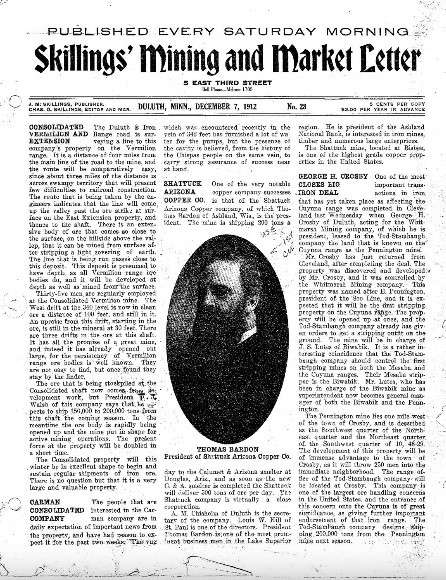
The first issue of Skillings’ Mining and Market Letter, 1912 — the publication that would become Skillings Mining Review.
A Name That Evolved With the Industry
Publications that endure change — not their standards, but their shape. The name evolution of Skillings over more than a century reflects the industry it covers: deliberate, incremental, and always grounded in substance.
Founded as a weekly in Duluth, Minnesota. Covered iron ore markets, shipping lanes, and the industrial heartland of the Upper Midwest.
Renamed to reflect the publication’s broader scope beyond market letters — it was now a full trade review covering the range of the mining industry.
The apostrophe was dropped, modernizing the masthead while preserving more than eight decades of institutional identity built around the Skillings name.
A fully digital platform combining the magazine, newsletter, job board, podcast, webinars, and archive library — reaching mining professionals on every continent.
The Editorial Legacy of David N. Skillings Jr.
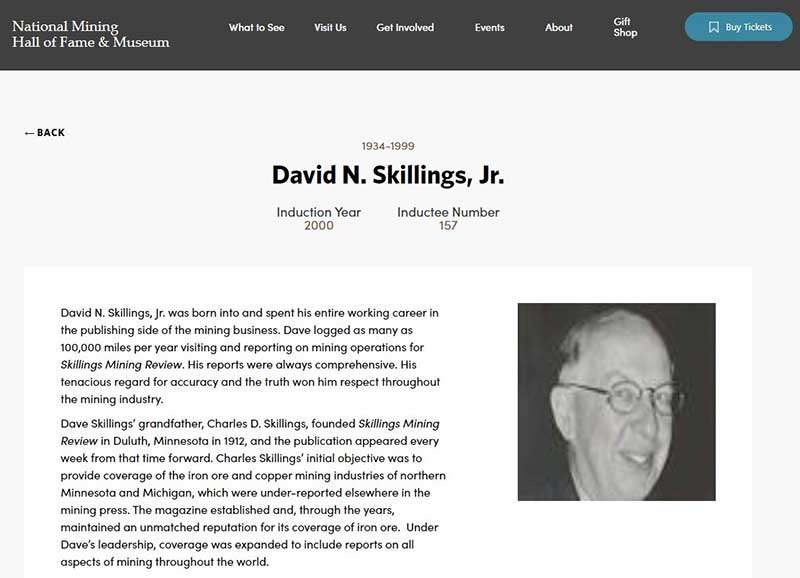
The name on the masthead was never just a brand. David N. Skillings Jr. shaped the publication’s editorial character across a defining period of its history, establishing the standards of sourcing, industry access, and analytical depth that made Skillings Mining Review the reference point for serious industry participants rather than a trade newsletter skimming the surface.
Under that editorial stewardship, the publication built a reputation for covering the full arc of mining life — not just the financials and production numbers, but the human dimensions of the industry. In particular, regular features documented the opening of prominent mines, traced the trajectories of significant industry mergers, reported on labor strikes with fairness to all parties, recorded production benchmarks, and published biographical sketches of the men and women driving the industry forward.
Above all, that editorial tradition — specificity over generalization, primary sources over second-hand accounts, industry access over detached commentary — remains the standard Skillings Mining Review holds itself to today.
The National Mining Hall of Fame Connection
Since 1987, the National Mining Hall of Fame and Museum in Leadville, Colorado has served as a national monument to the men and women who have championed the discovery, development, and responsible processing of the earth’s natural resources. Its mission — to educate the public about mining’s relationship to everyday life — mirrors the editorial mission Skillings has carried since 1912.
Furthermore, the connection between Skillings Mining Review and the Hall of Fame runs deeper than historical proximity. Both institutions exist to preserve and communicate the significance of an industry that underpins modern civilization. Consider that every metal in every device, every structure, and every grid came from mining. The Hall of Fame honors the people who made that possible, while Skillings covers the industry they built and the industry their successors are transforming today.
In that same spirit, the Hall of Fame’s location in Leadville is a reminder of where American mining history was written — in the mountains, the shafts, and the smelters of the American West. Skillings, meanwhile, was on the docks of Duluth at that very same moment. Together, therefore, they document a century of American resource history that might otherwise go unrecorded.
National Mining Hall of Fame and Museum, Leadville, CO — honoring mining’s champions since 1987.
What Skillings Mining Review Covers Today
The industry that Skillings Mining Review covered in 1912 was built on iron ore and coal. Today, however, coverage extends across the full periodic table — encompassing the geopolitical, financial, and technological forces that determine which nations control access to it. While the subjects have expanded enormously, the editorial discipline has not.
Indeed, the defining story of mining in the 2020s is critical minerals. The energy transition, the electrification of transport, the demands of AI infrastructure, and the reordering of global supply chains have placed mining at the center of national security conversations in ways that would have been unfamiliar to the Duluth dock workers of 1912 — although they would not have surprised the editors of this publication. Skillings has always understood that mining is not simply a commodity sector; rather, it is the foundation layer of every other industry.
Critical Minerals Intelligence
Lithium, cobalt, rare earths, copper, nickel — the minerals at the center of the energy transition and the strategic competition between nations.
Mining Finance & Capital Markets
Equity raises, streaming deals, M&A activity, royalty structures, and the capital flows shaping project development globally.
Exploration & New Discoveries
Greenfield discoveries, drill results, resource estimates, and the geologies attracting the next wave of investment.
Mining Technology & Automation
Autonomous haulage, AI-driven predictive maintenance, remote operations, and the digital transformation of underground and surface mining.
ESG & Responsible Mining
Environmental commitments, community engagement, Indigenous partnerships, water stewardship, and the social license to operate.
Energy & the Mining Transition
Decarbonizing operations, electrification of fleets, hydrogen applications, and the energy cost pressures reshaping mine economics.
Policy & Geopolitics
Permitting reform, export controls, friend-shoring strategies, and the regulatory environment in key mining jurisdictions worldwide.
Workforce & Safety
Skills shortages, immigration and labor policy, training programs, and the safety standards protecting the people who work underground.
Who Reads Skillings Mining Review
Skillings Mining Review has never been a publication for the general interest reader. Its audience is the global community of professionals for whom mining is not background noise but the central fact of their working lives. Those readers expect primary reporting, direct access to data, and analysis that respects their expertise rather than explaining the basics back to them.
- C-suite executives at major and mid-tier mining companies
- Mining investors and portfolio managers
- Exploration geologists and technical specialists
- Mining equipment and technology suppliers
- Investment bankers and M&A advisors in mining
- Government ministers and policy advisors
- Environmental and sustainability officers
- Junior mining company leadership and boards
- Mining lawyers, consultants, and engineers
- Academic researchers in mining and resources
With more than 15,000 followers on LinkedIn, a 3× weekly member newsletter, a monthly magazine, and an archive library spanning more than a century of the industry, Skillings Mining Review gives this audience the intelligence they need in the formats that fit how they work — whether that is a breaking news alert, a long-form feature, a webinar, or a deep archive search.
The Skillings Editorial Promise
More than a century of publication creates an obligation that goes beyond content volume. Readers who have trusted Skillings Mining Review across careers — and across generations — have earned a clear statement of what this publication stands for.
We cover mining with the rigor it deserves. That means going beyond press releases to the underlying data, beyond company statements to industry context, beyond the news cycle to the structural trends that will still matter in five years. It means giving equal weight to the engineering realities and the financial dynamics. It means covering the communities around mines with the same seriousness we bring to the capital flows into them.
It means treating the critical minerals story — the defining resource story of this decade — as exactly what it is: a convergence of geology, geopolitics, technology, and finance that will shape which nations prosper and which fall behind. Skillings Mining Review exists to give its readers an advantage in navigating that convergence.
We are not a neutral aggregator. We are an editor’s publication — with a point of view, a standard for sourcing, and more than 110 years of institutional knowledge informing every story we publish.
Join the Skillings Mining Review Community
Access the full archive, 3× weekly newsletter, monthly magazine, global job board, and member forums. Engage with 15,000+ mining professionals on LinkedIn.
Explore Skillings Mining Review
The breadth of what Skillings Mining Review covers today is best understood by reading it. The links below are a starting point for new readers and a quick navigation guide for returning members.